
Appearance
Chapter 7: Exercise—What Actually Helps Your Bones
7
"Exercise is good for your bones." You've heard it a million times. But here's the thing: not all exercise is created equal when it comes to bone health. Some activities are fantastic. Others? Barely move the needle.
How Bones "Feel" Exercise
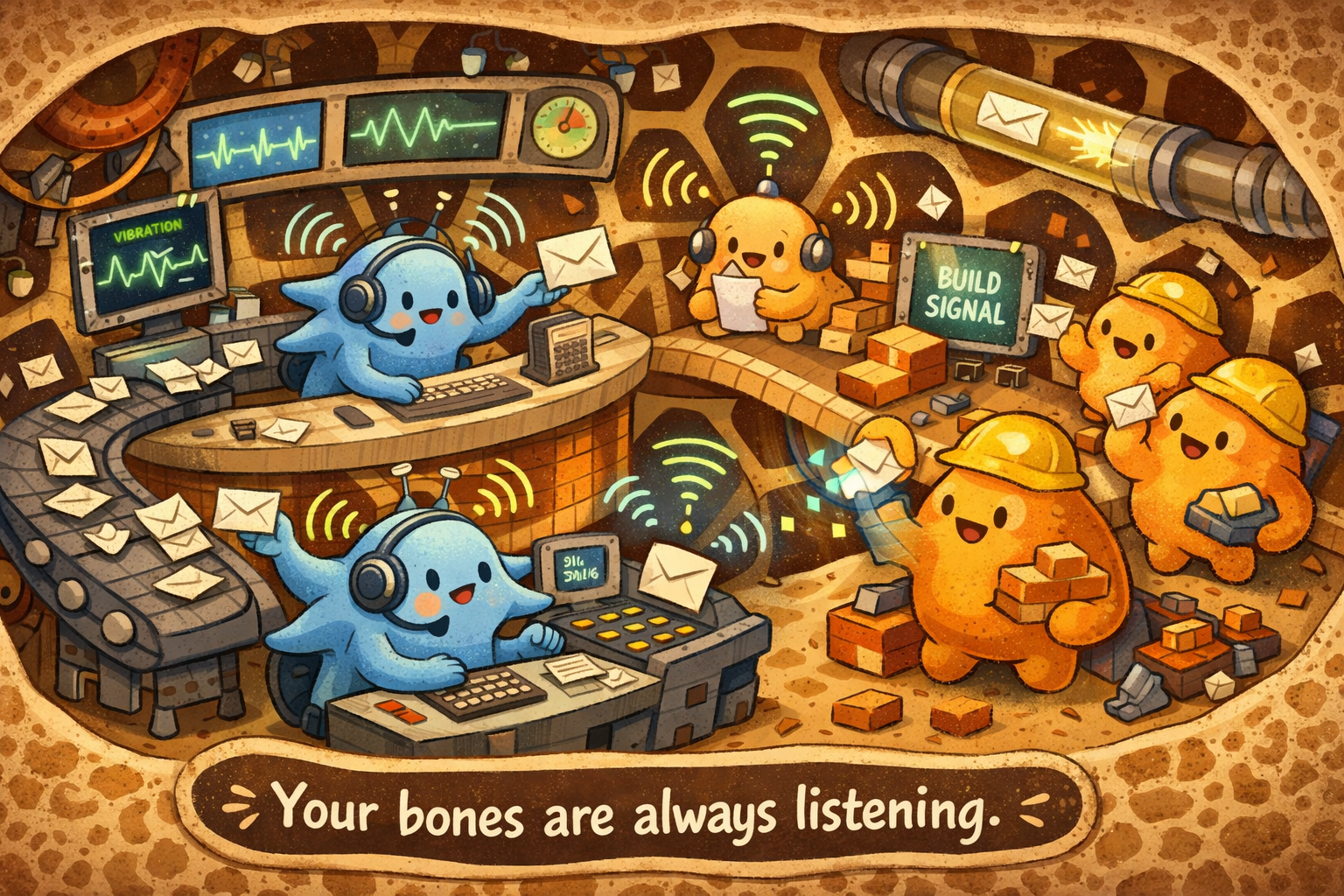
Your bones are constantly listening to your body. When you move, fluid flows through tiny channels inside your bones, and special cells (osteocytes) detect this movement. They then send signals: "Hey, we need reinforcement here!"
Think of it like this: your bones adapt to the demands you place on them. Challenge them, and they get stronger. Don't challenge them, and they figure, "Why bother maintaining all this?"
What Makes Exercise Good for Bones?
Not all movement stimulates bone building. Here's what your bones respond to:
1. Big Forces
The harder the impact, the stronger the signal. Jumping creates 2-5 times your body weight in force. Walking? Only about 1.5 times. Swimming? Basically zero (buoyancy removes the load).
2. Speed Matters
Quick, sudden forces beat slow, steady ones. A fast jump sends a stronger signal than a slow squat—even if the peak force is similar.
3. Novelty Is Key
Your bones get bored. If you've been walking every day for years, walking won't stimulate much new bone. Your skeleton has already adapted. You need to surprise it with something different.
4. Rest Between Efforts
Interestingly, your bone cells get "tired" with continuous loading. Short bursts with breaks between them work better than one long continuous session.
The PTH Parallel: Why Exercise Works Like Bone Medication
Here's something fascinating: exercise affects bone in exactly the same way as teriparatide (Forteo)—the anabolic bone drug that mimics PTH pulses.
Pulsatile = anabolic. When PTH comes in short bursts (whether from a teriparatide injection or an exercise session), it triggers bone formation. The temporary spike activates osteoblasts and tips the remodeling balance toward building.
Continuous = catabolic. But when PTH is constantly elevated (as in hyperparathyroidism), it does the opposite—it breaks bone down. The same molecule, different pattern, opposite effect.
Exercise follows the same rules:
- Short, intense sessions with recovery → anabolic stimulus → bone building
- Chronic overload without adequate rest → accumulated microdamage → stress fractures
Bone Is Built During Recovery, Not During Exercise
Just like muscle, bone doesn't get stronger while you're training—it gets stronger while you're resting afterward. The exercise session creates the signal. The hours and days of recovery are when your osteoblasts actually respond to that signal and lay down new bone.
This is why consistency matters more than intensity alone. A moderate jumping routine 3x/week with rest days will build more bone than daily high-impact training that never lets your skeleton catch up. Push too hard for too long, and you shift from the anabolic "PTH pulse" pattern into the catabolic "constant PTH" pattern—microcracks accumulate faster than they're repaired, and stress fractures follow.
The Exercise Hierarchy for Bones
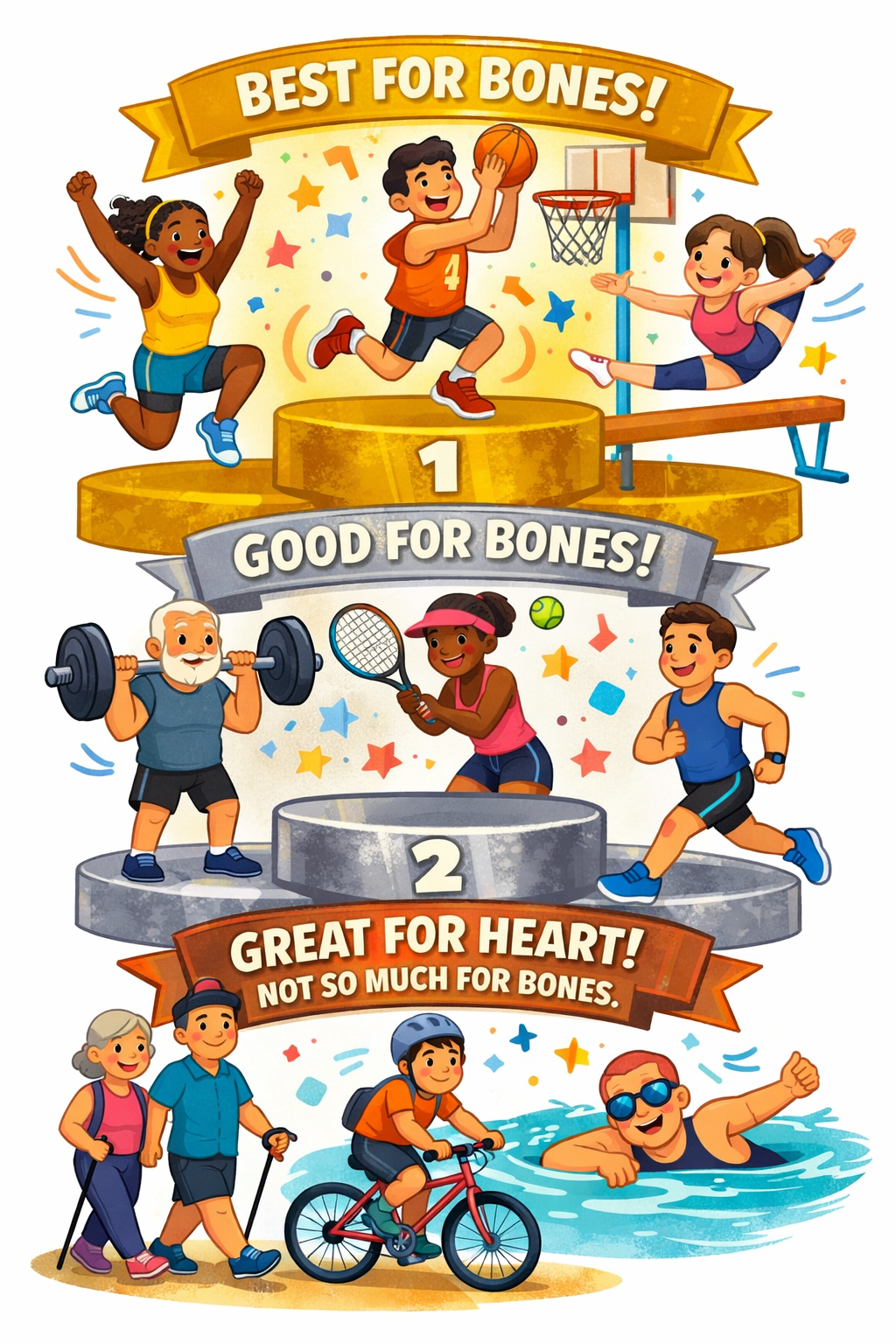
Let's rank activities by how much they help your bones:
The Stars (High Impact)
| Activity | Why It Works |
|---|---|
| Jumping & plyometrics | Huge forces, fast loading |
| Basketball, volleyball | Lots of jumping and direction changes |
| Gymnastics | Extreme forces on landing |
| Sprinting | High impact running |
These are the gold standard for bone building.
The Solid Performers (Moderate Impact)
| Activity | Why It Works |
|---|---|
| Strength training | Heavy loads, muscle pulling on bone |
| Tennis, soccer | Running + direction changes |
These help maintain and can modestly improve bone density.
Note on strength training: It can move into the "Stars" category—but only if loads are genuinely heavy (think: heavy squats, deadlifts at challenging weights). The problem? Most people don't have the strength base to move enough weight to generate star-level bone stimulus. Light dumbbells and machine circuits, while good for general fitness, won't cut it for serious bone building.
The Disappointers (Low/No Impact)
| Activity | The Problem |
|---|---|
| Walking (flat) | Too gentle, body's already adapted |
| Cycling | Seated, smooth pedaling = minimal bone stress |
| Swimming | Buoyancy removes nearly all skeletal loading |
| Most yoga | Slow, gentle movements |
The Swimming and Cycling Surprise
These are EXCELLENT for your heart, muscles, and overall health. But studies consistently show competitive swimmers and cyclists have bone density similar to—or sometimes lower than—couch potatoes.
If these are your main activities, you need to add some impact exercise for your bones.
The Running Reality
Here's something that surprises many people: running doesn't really build bone density.
Despite being "weight-bearing," running is actually relatively low impact. Each footstrike generates only about 2-3x body weight—compared to 5-10x for jumping. And because it's repetitive and predictable, your skeleton quickly adapts and stops responding.
The evidence:
- Distance runners have only marginally higher bone density than sedentary people
- Some studies show no difference at all
- Competitive runners who don't cross-train often have surprisingly average bone density
But here's the catch—stress fractures:
Running may not build bone, but its repetitive nature can cause stress fractures. This seems contradictory, but it makes sense:
- Each stride is low impact, but you take thousands of strides per run
- Microdamage accumulates faster than it can be repaired
- If you ramp up mileage too quickly, or run with energy deficiency, the bone can't keep up
- Result: stress fractures, especially in the tibia, metatarsals, and femoral neck
The Runner's Dilemma
Running is excellent for cardiovascular health, mental health, and many other benefits. But if bone density is your goal, running alone won't get you there. Add jumping, strength training, or other high-impact activities to your routine.
Age Changes Everything
Kids and Teens: The Golden Window
Bones respond dramatically to exercise during growth. Even short jumping sessions (10-20 minutes, 3x/week) can significantly increase bone density. These benefits can last into adulthood!
Why are young bones so responsive?
It comes down to two factors: faster remodeling and heightened mechanosensitivity.
Higher hormone levels accelerate everything. Children and teenagers have growth hormone (GH) and IGF-1 levels 2-4x higher than adults. This cranks up the entire bone remodeling system—osteoblasts and osteoclasts both work faster and more efficiently.
Young bone cells are more sensitive to loading. Research shows that growing bone has a fundamentally greater capacity to respond to mechanical stress than adult bone. The osteocytes (mechanosensing cells) and osteoblasts (building cells) in young skeletons are more active and more responsive to the same loading stimulus. When a child jumps, their bone cells "hear" that signal louder and respond more vigorously than adult cells would.
This enhanced responsiveness appears to decline after puberty. As IGF-1 levels drop following growth plate closure, skeletal sensitivity to mechanical loading decreases. The same exercise that would trigger robust bone formation in a 10-year-old produces a much weaker response in a 30-year-old—not because the adult is doing anything wrong, but because their bone cells simply aren't as reactive anymore.
When young bones sense mechanical stress from exercise, the response is rapid and robust:
- The signal to "build here" gets acted on quickly
- The bone-building cells (osteoblasts) are abundant, active, and highly responsive
- New bone can be deposited within weeks, not months
The same exercise, different results: A 12-year-old and a 40-year-old could do the exact same jumping program for 6 months. The child might gain 5-8% bone density at the hip. The adult might gain 1-2%—or just prevent loss.
It's not that the adult is doing something wrong. Their bone remodeling machinery simply runs slower. The signal is heard, but the response takes longer and produces less.
The Implication for Young Athletes
This is why childhood and teenage years are such a critical investment period. The bone density gains from youth sports can persist for decades—even if the person stops the activity later. You're front-loading your skeleton with reserves it will draw on for life.
Adults: Diminished But Real
Adult bones still respond, but:
- The effect is smaller
- It takes longer
- You need more intense stimulus
Realistic expectations for adults:
- Prevent or slow loss
- Modest gains (1-3% over 6-12 months with dedicated programs)
- Every bit helps!
Older Adults: Prevention and Protection
For seniors, exercise benefits extend beyond bone density:
- Better balance (fewer falls)
- Stronger muscles (catch yourself when you trip)
- Even small density preservation is valuable
The Hormone Requirement
Here's a critical point: Exercise can't build bone without proper hormones.
| Hormones | Exercise | Result |
|---|---|---|
| Adequate | Adequate | Optimal |
| Adequate | Lacking | Suboptimal |
| Low | Adequate | Limited benefit |
| Low | Lacking | Poor |
Why Hormones Are Essential for Exercise to Work
This isn't just about hormones being "nice to have"—they're fundamentally required for your bones to even sense exercise.
Estrogen affects mechanosensing itself: Osteocytes (the cells that detect mechanical stress) have estrogen receptors. When estrogen is adequate, these cells are exquisitely sensitive—even the mild strains of daily activities trigger appropriate bone maintenance signals.
When estrogen is deficient, research shows osteocytes fail to respond to normal loading. The mechanosensing machinery on their surface is reduced by nearly half. They become "deaf" to the signals that should prompt bone formation.
The result: In estrogen-deficient individuals, only high-intensity exercise (jumping, running, heavy lifting) generates enough force to trigger a bone-building response. The everyday walking and movement that would maintain bone in a hormone-replete person simply doesn't register.
The Double Problem of Menopause
Postmenopausal bone loss isn't just about faster breakdown—it's a fundamental change in how remodeling works:
In healthy bone, remodeling is targeted and local. Osteocytes detect microdamage at specific sites, signal osteoclasts to remove the damaged area, then osteoblasts fill it in. It's like patching potholes as they appear.
After menopause, estrogen deficiency triggers a dramatic increase in activation frequency—the number of new remodeling sites started per unit time. Instead of targeted repairs, the system goes into overdrive everywhere. It's like tearing up entire roads instead of patching potholes.
Worse, at each of these numerous remodeling sites, osteoclast activity is enhanced while osteoblast activity lags behind (uncoupling). The result: bone loss at many locations simultaneously, plus disruption of the trabecular architecture.
This is why HRT can be so effective for bone—it doesn't just slow osteoclasts, it restores the normal targeted remodeling pattern and restores osteocyte mechanosensitivity.
You Can't Out-Exercise Hormone Deficiency
- Female athletes with missing periods lose bone despite intense training
- Men with low testosterone don't respond well to exercise
- Postmenopausal women have blunted exercise response—they need higher-intensity loading to get the same signal, this high intensity can lead into dangerous territory
If your hormones are off (missing periods, low energy, other signs), exercise alone won't protect your bones. Address the hormones first—or at minimum, understand that you'll need higher-impact exercise to compensate for reduced mechanosensitivity.
If You Already Have Osteoporosis
If your bones are already fragile:
- Skip high-impact activities (too risky)
- Focus on strength training (can be done safely)
- Prioritize balance exercises (fall prevention!)
- Consider supervised osteoporosis exercise classes
- Ask your doctor or physical therapist for guidance
Why Strength Training Matters
Lifting weights helps bones through:
- Muscle pull: Strong contractions tug on bones
- More muscle mass: More weight to carry around
- Fall prevention: Stronger = better able to catch yourself
Best exercises for bones:
- Squats and deadlifts (spine and hip loading)
- Lunges (hip loading)
- Step-ups
- Overhead press (spine loading)
The Bottom Line
Exercise can help your bones—but only the right type, and only if your hormones are in order.
Key takeaways:
- High-impact, quick, novel movements stimulate bones best
- Swimming and cycling are great for health but not for bones
- Running helps but has diminishing returns
- Youth is the golden window for exercise-induced bone gains
- Hormones are a prerequisite—exercise can't overcome deficiency
- Strength training complements impact exercise
- Older adults benefit from balance and fall prevention too
Next up: nutrition and bone—why eating enough matters more than calcium supplements.