
Appearance
Chapter 6: Why Men's and Women's Bones Are Different
6
Men and women don't just have different hormones—they have fundamentally different skeletons. Understanding these differences explains a lot about who gets osteoporosis and why.
Men Have Bigger Bones (And It Matters More Than You Think)
On average, men's bones are:
- 25% larger in cross-section at the spine
- 20% wider at the hip
- 10-15% thicker in the outer shell
Before puberty, boys and girls have similar-sized bones. The difference emerges during the teenage years:
Boys: Testosterone makes bones grow wider. Boys grow for longer and end up with larger-diameter bones.
Girls: Estrogen accelerates growth but also closes the growth plates sooner. Women end up with narrower bones.
Why Size Is a Big Deal
Here's the physics that matters: bone strength doesn't just scale with size—it scales with size to the fourth power for bending resistance.
In plain English? A small increase in diameter = a HUGE increase in strength.
Real example: A bone that's 20% wider is nearly TWICE as strong against bending—even if the wall thickness is the same.
The DXA Paradox: Size vs. Density
Here's something counterintuitive: when researchers use 3D imaging (QCT) to measure volumetric bone density (actual mineral per cubic centimeter), men's bones are comparable to or even slightly less dense than women's.
Wait—if men's bones aren't denser, why do they show higher BMD on DXA scans?
The answer lies in what DXA actually measures. DXA gives you areal BMD (grams per square centimeter)—it's looking at a flat 2D projection of a 3D bone. A larger bone casts a bigger "shadow" and appears denser, even if the actual tissue density is the same.
| Measurement | What It Shows | Men vs. Women |
|---|---|---|
| DXA (areal BMD) | Mineral per cm² of projected area | Men higher |
| QCT (volumetric BMD) | Mineral per cm³ of actual bone | Similar or men slightly lower |
The takeaway: Men's bone advantage comes from geometry (larger size), not from having denser bone tissue. This is why the interactive tool below matters—it shows how much geometry contributes to strength.
Cortical Bone Comparator
Visualize the impact of geometry on Bone Mineral Density (BMD) and Bending Strength.
Reference
Diameter: 25mmThickness: 5mm
Ref BMD100%
Ref Strength100%
Modified
BMD0.0%Cross-Sectional Mass
Strength (Bending)0.0%Moment of Inertia
25.0mm
10mm45mm
5.0mm
1mm20mm
Did you know? Moving mass away from the center (increasing diameter) increases bending strength exponentially (r⁴), much more than just adding thickness.
The Internal Architecture Difference
Inside the bone, there are differences too:
Men's trabecular bone (the inner honeycomb):
- Thicker supporting struts
- More robust connections
Women's trabecular bone:
- More numerous but thinner struts
- More susceptible to complete breakdown
Here's the crucial part: When bone loss occurs with aging, women tend to lose entire struts (they dissolve completely), while men's struts just get thinner but stay connected.
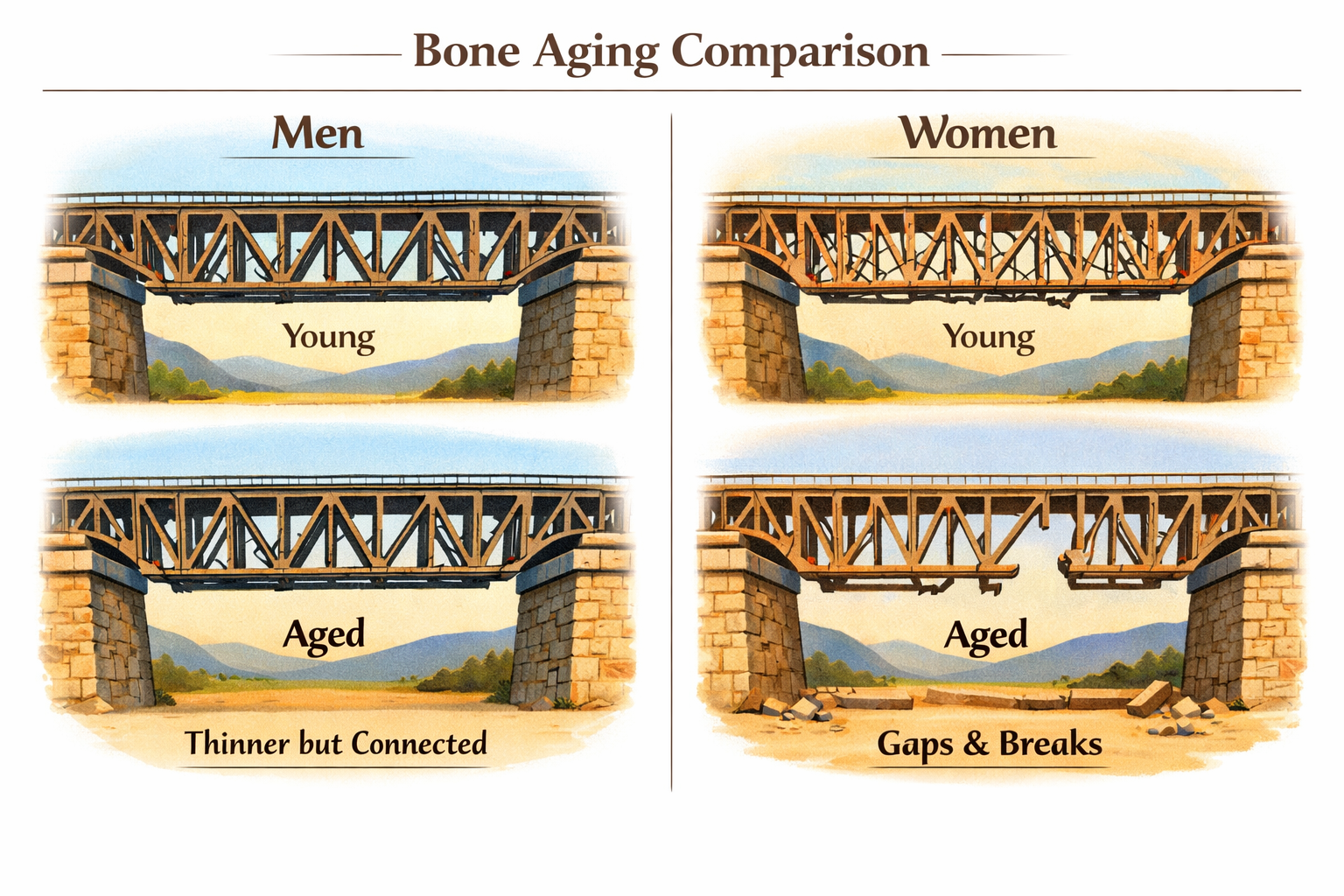
Once a strut is completely gone, it can't be rebuilt. This architectural damage is largely permanent, which is why prevention matters so much.
Different Aging Patterns
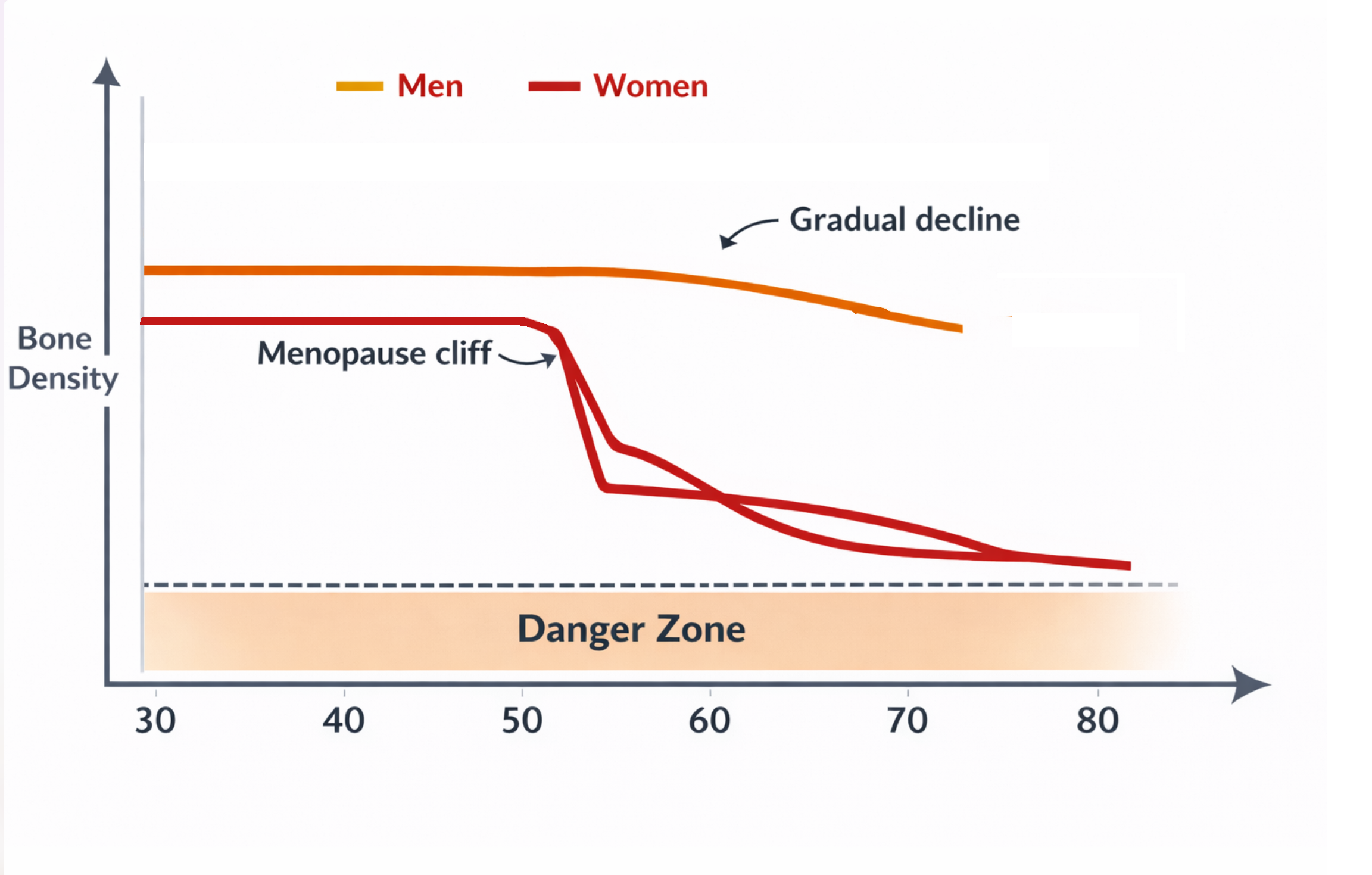
Women: The Menopause Cliff
When menopause hits, estrogen drops suddenly and dramatically:
- Bone breakdown accelerates rapidly
- Women may lose 2-3% of spine density PER YEAR for 5-10 years
- The spine and wrist are hit first and hardest
- Eventually things slow down, but the rapid phase does significant damage
Men: The Gradual Slide
Men don't have a menopause equivalent:
- Testosterone (and the estrogen made from it) declines slowly—about 1% per year after 40
- Bone loss is gradual and steady, no sudden cliff
- But here's the key: Men started with more bone, so they can lose the same percentage and still stay above the danger zone
Understanding Your Scores
Here's something important that surprises many people: At the same DXA-measured BMD, men and women have approximately the same fracture risk.
A T-score of -2.5 compares you to a healthy young person of YOUR sex. You might think that because men's bones are bigger, a -2.5 man would still be better off than a -2.5 woman. But research from large studies (Rotterdam, EPOS) shows this isn't the case.
Why? Because DXA already captures much of the size advantage. A larger bone produces a higher BMD reading on DXA. So when a man's BMD drops to -2.5, he's lost enough bone that his fracture risk is similar to a woman at the same score.
What This Means
Don't assume men are "safer" at the same T-score. Fracture risk calculators like FRAX use the same BMD thresholds for both sexes because the risk is genuinely comparable.
The Invisible Problem: Male Osteoporosis
Despite lower rates, male osteoporosis is a serious issue that's massively underdiagnosed:
- Only 5-10% of men with osteoporosis are diagnosed
- Men who break bones are less likely to get screened or treated
- Hip fractures in men have HIGHER death rates than in women
Men Get Osteoporosis Too
If you're a man over 70, or over 50 with risk factors (previous fracture, steroid use, low testosterone, etc.), you should be screened. Osteoporosis isn't just a "women's disease."
Treatment Differences
For women:
- Earlier intervention often makes sense
- Menopause is a key time to assess
- Hormone therapy may be an option for some
For men:
- Often diagnosed later (less screening)
- Should check for underlying causes like low testosterone
- Same medications work, just studied less in men
The Bottom Line
Men and women have fundamentally different skeletons. Size, structure, and aging patterns all differ—but estrogen protects bones in both sexes.
Key takeaways:
- Men's bones are larger, giving them a strength advantage through geometry
- Men's volumetric bone density is actually similar to (or lower than) women's—size is the key difference
- Bone strength scales dramatically with diameter (to the fourth power)
- Women lose bone rapidly at menopause; men decline gradually
- At the same DXA-measured BMD, men and women have similar fracture risk
- Male osteoporosis is common, dangerous, and undertreated
- Estrogen matters for both sexes
Next up: we'll explore how exercise affects bones—and why some activities help while others don't.